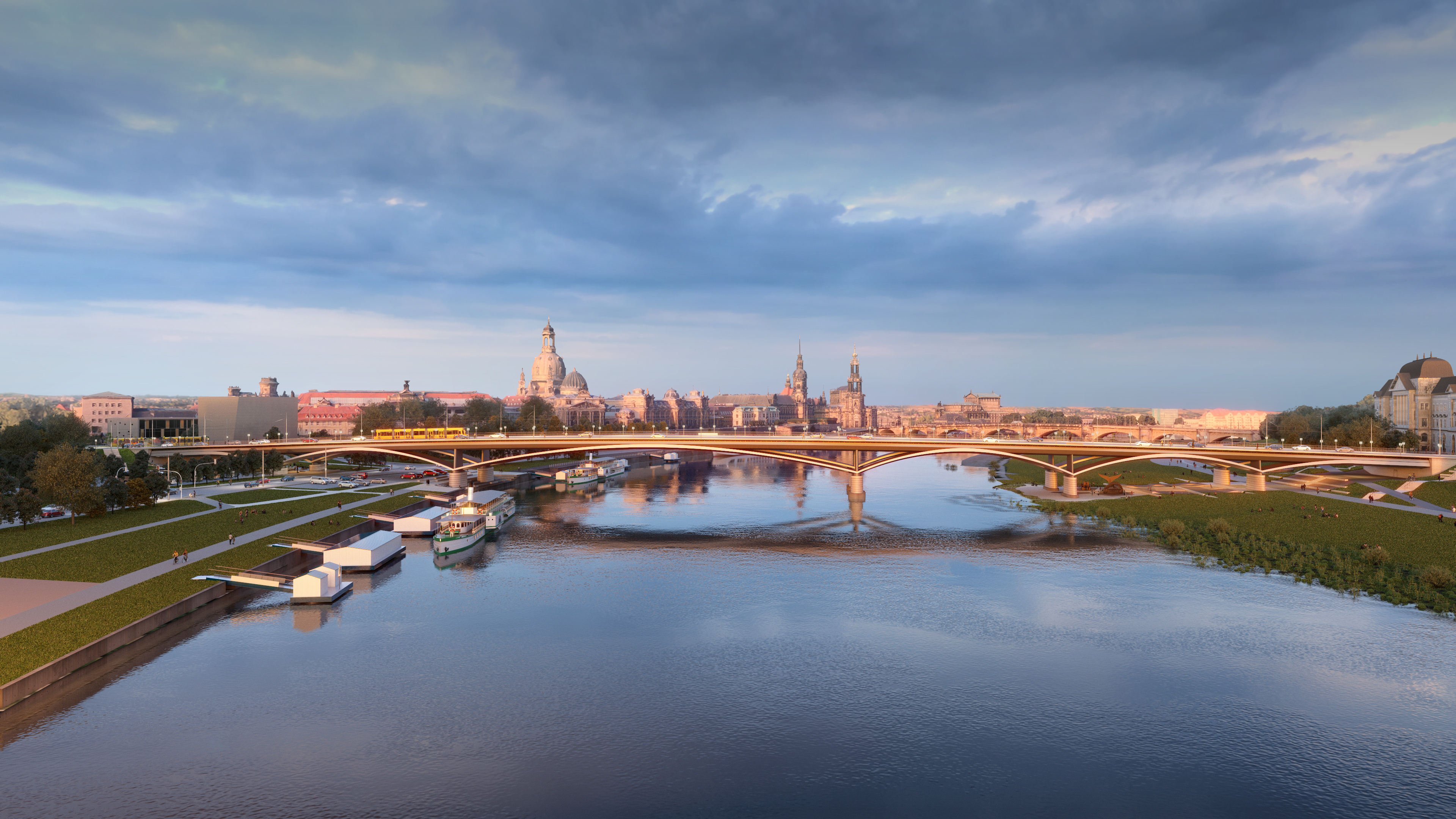
01 main_IA_11094.jpg
Carolabrücke 3.0
Dresden, Germany
Structural typology Tender Design
Date 2026
Umfang Tender design
Cliente City of Dresden
Design Fhecor
Collaboration TSSB | UKL
Owner City of Dresden
DESIGN PHILOSOPHY
It is not often that a bridge in the heart of a historic city can be completely reimagined. The failure of the bridge built in 1971 presents Dresden with an opportunity. The unfortunate collapse of the bridge offers a chance to reconnect the city in a new way and to rethink the separated districts with an urban and engineering vision suitable for the 21st century.

In redesigning the bridge, we considered it essential to create a more compact and versatile structure that can respond to both current requirements and future changes. From our perspective, building a bridge with three separate superstructures, as in the Carola 2.0, is too inflexible and would occupy an excessive amount of space. It makes little sense to design a purely road or rail bridge, as it would not match the quality of the urban and landscape space.

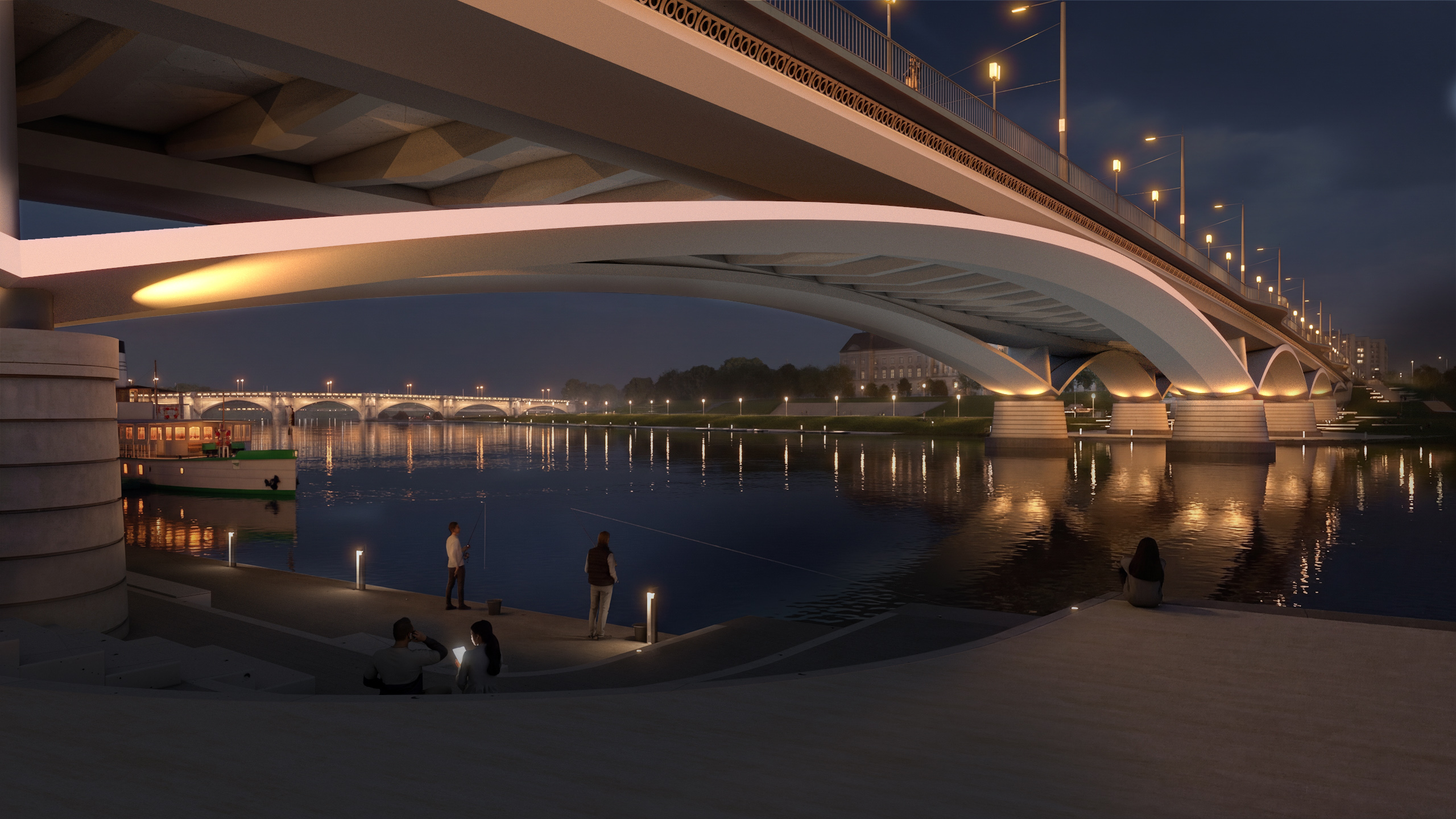
Our intention, therefore, is to design a "calm" bridge—one where the experience of crossing is important for all users, including pedestrians and cyclists, as well as an appreciation of the structure itself. Citizens and visitors expect this new bridge to possess a design quality worthy of the city.
Pro
From the perspective of 21st-century engineering and architecture, it would not be appropriate to simply reconstruct what the first Carolabrücke once was: a 19th-century design, shaped by the technology of its time. That first bridge combined tradition—represented by the approach spans as stone masonry arches—with modernity, embodied by the three very flat steel arch spans, whose axial forces were introduced into massive masonry piers. The first Carolabrücke thus represented a synthesis of tradition and modernity. The same spirit has guided our design.

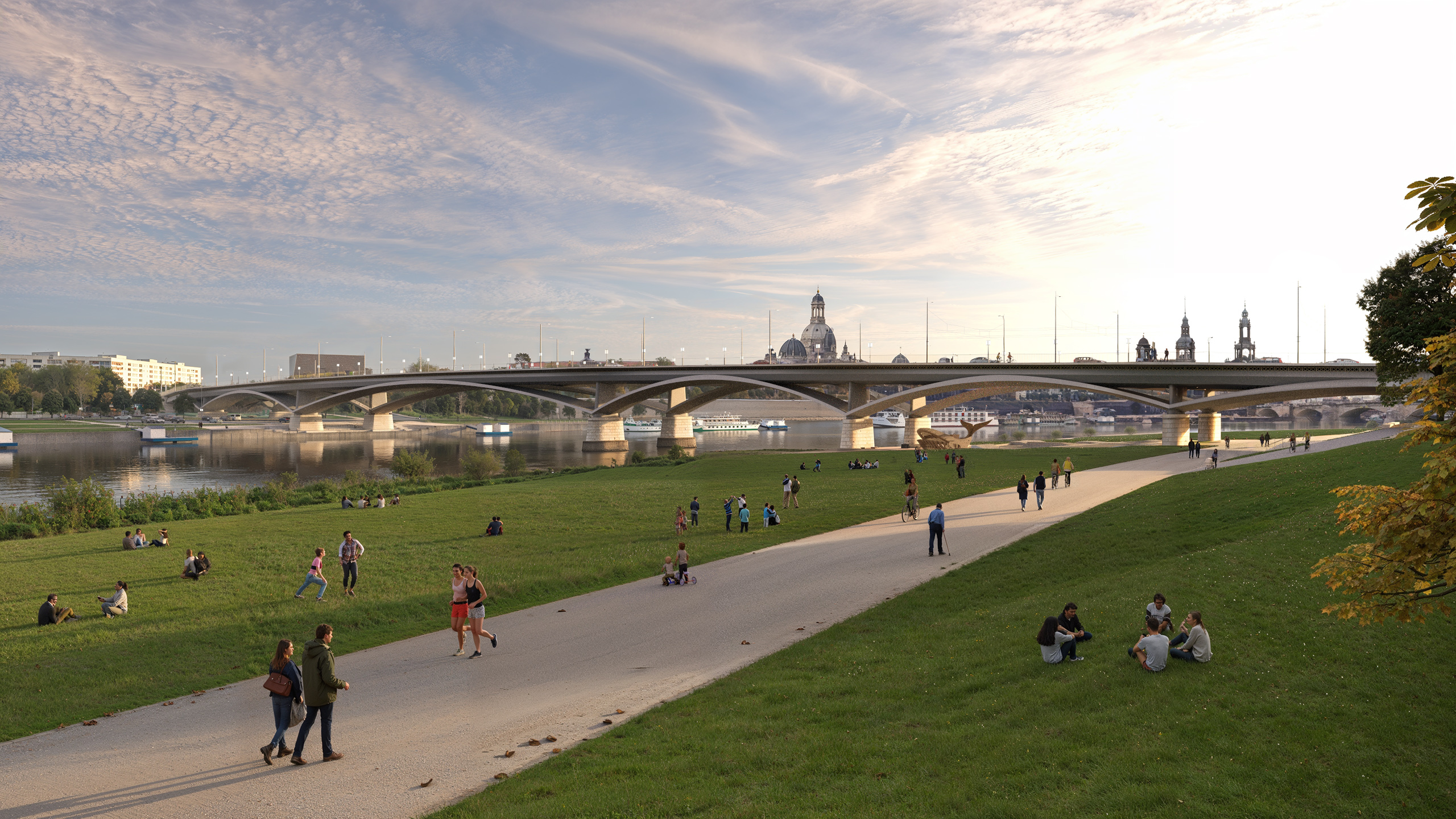
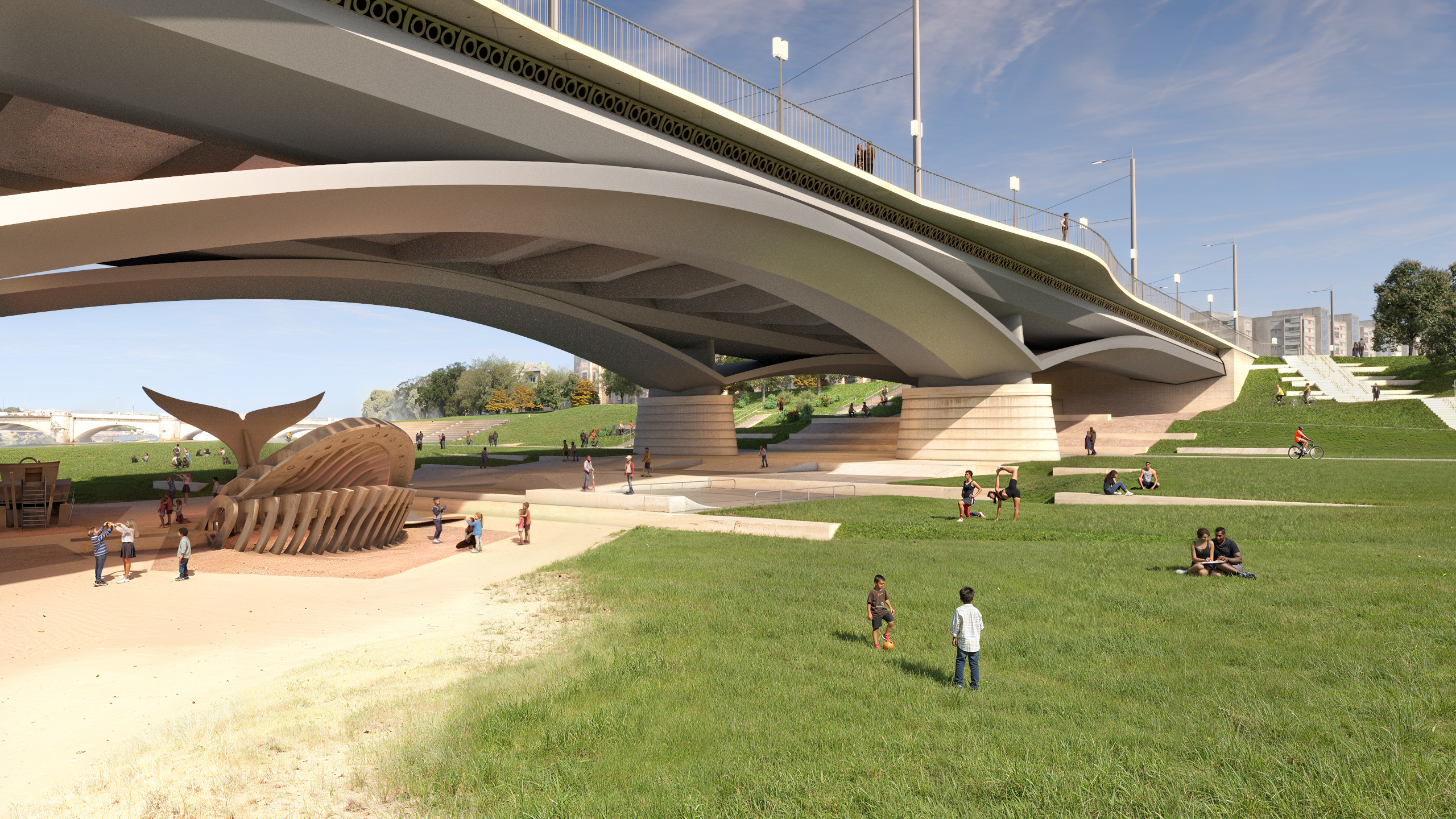
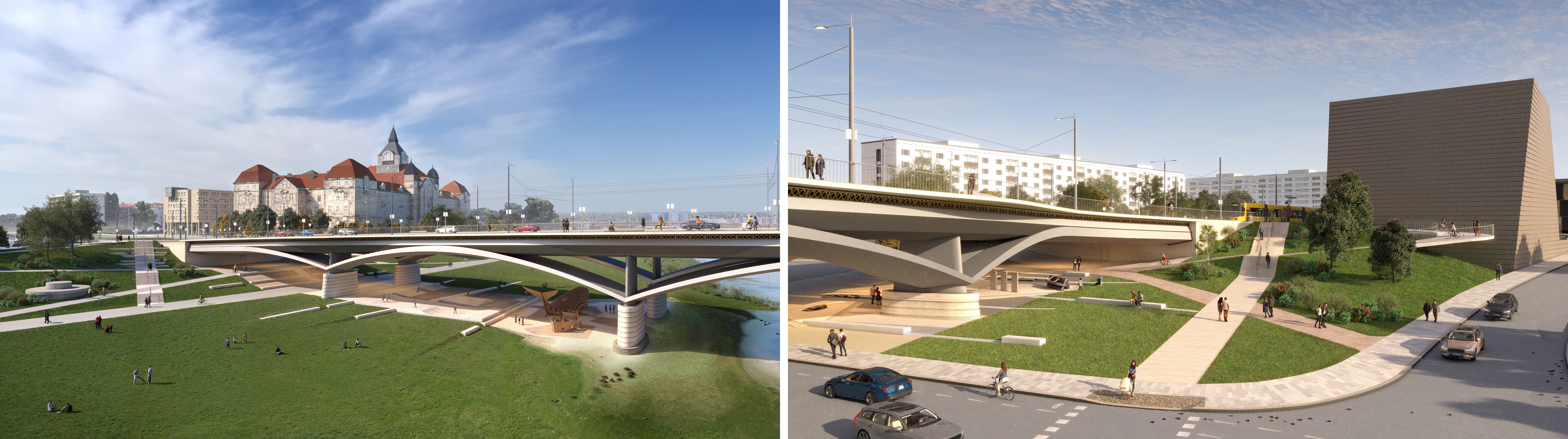
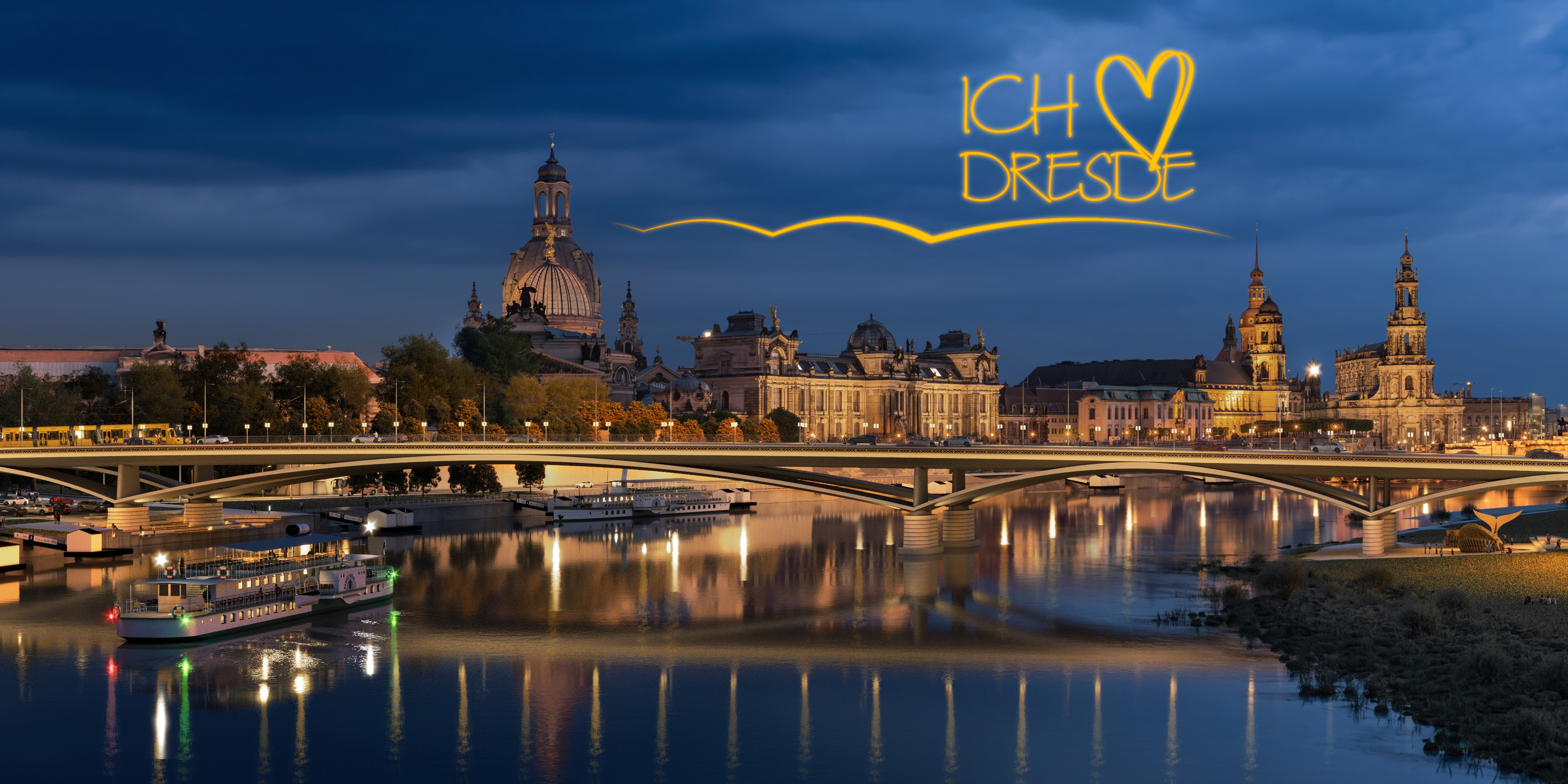
We propose a contemporary bridge that, with its classical character, also connects to the city’s structural history. Our solution is a multi-arch bridge that, on the one hand, responds to all existing boundary conditions and, on the other, becomes a bridge with character—one that can integrate dignifiedly into the city and be recognized as another bridge worthy of joining the ranks of Dresden’s significant historical bridges.

STRUCTURAL DESIGN AND TECHNICAL INTEGRATION
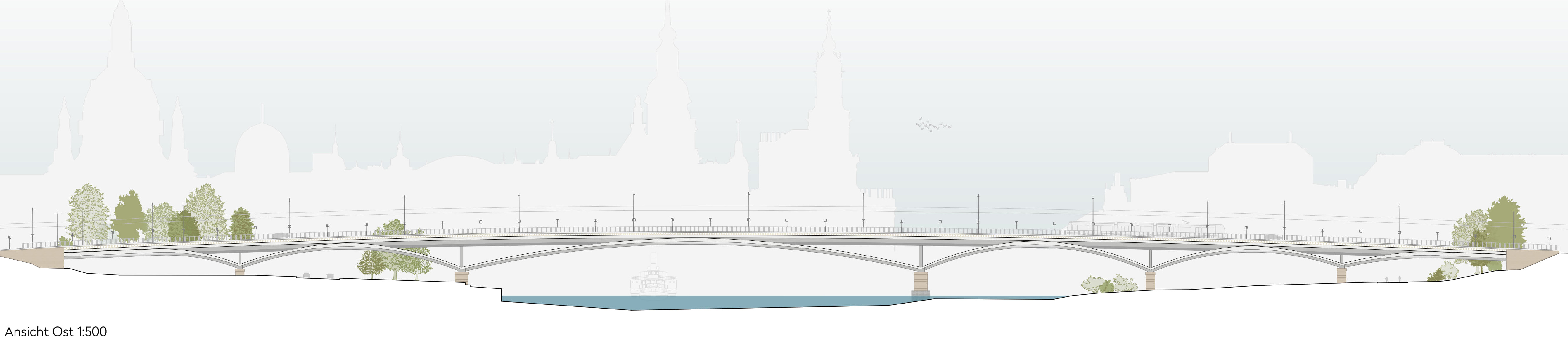
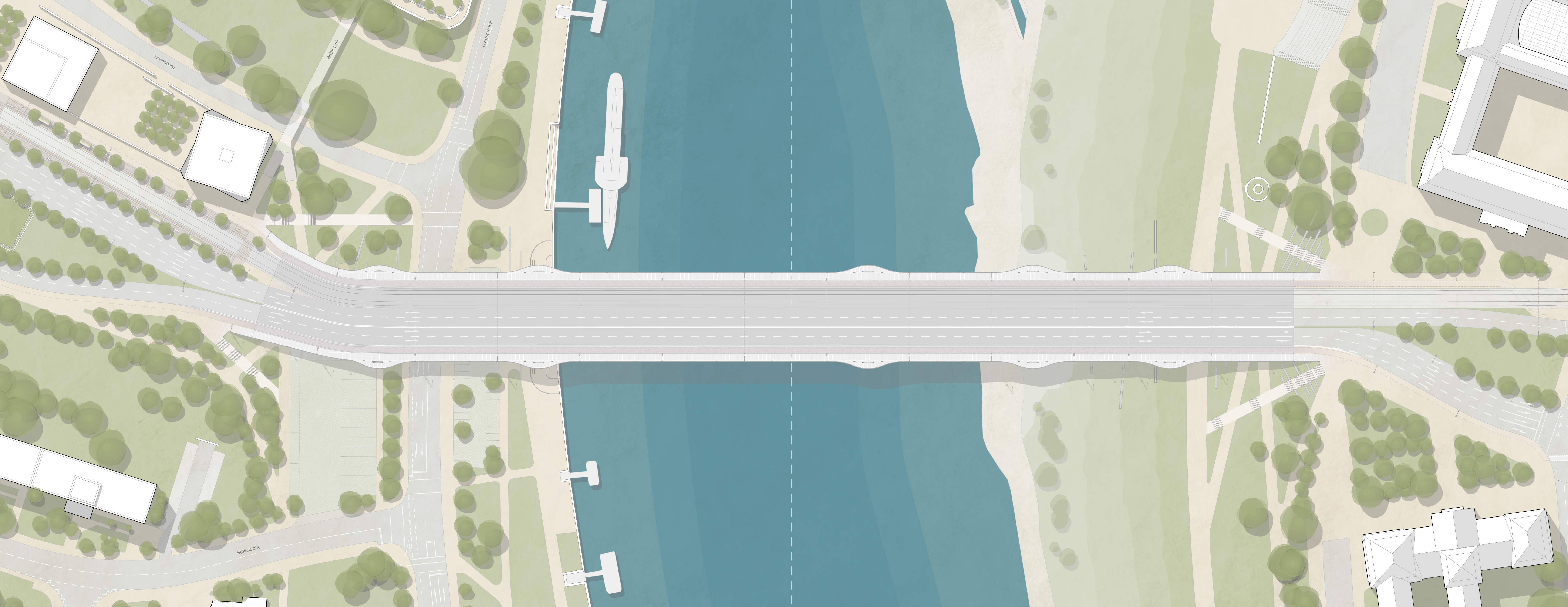
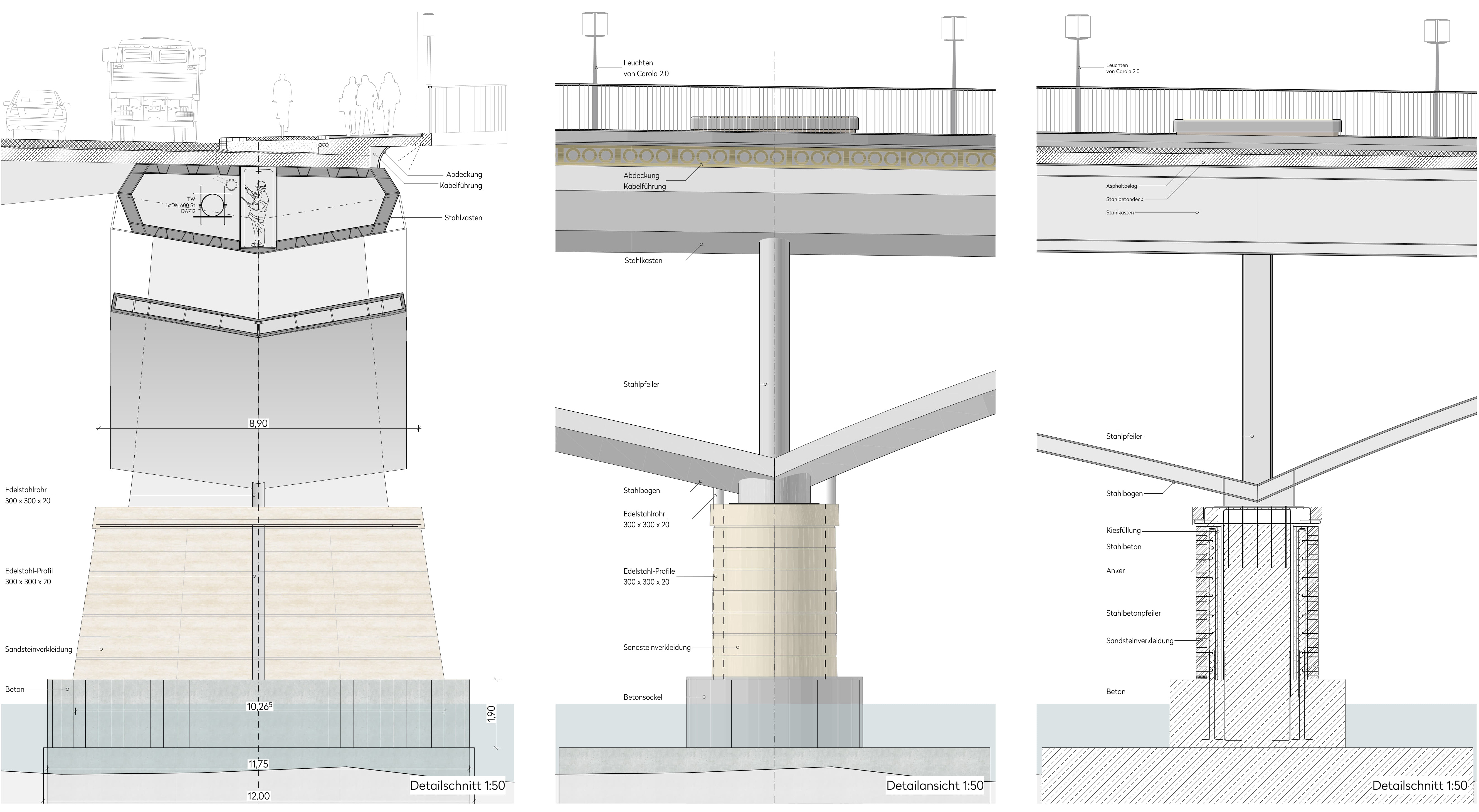
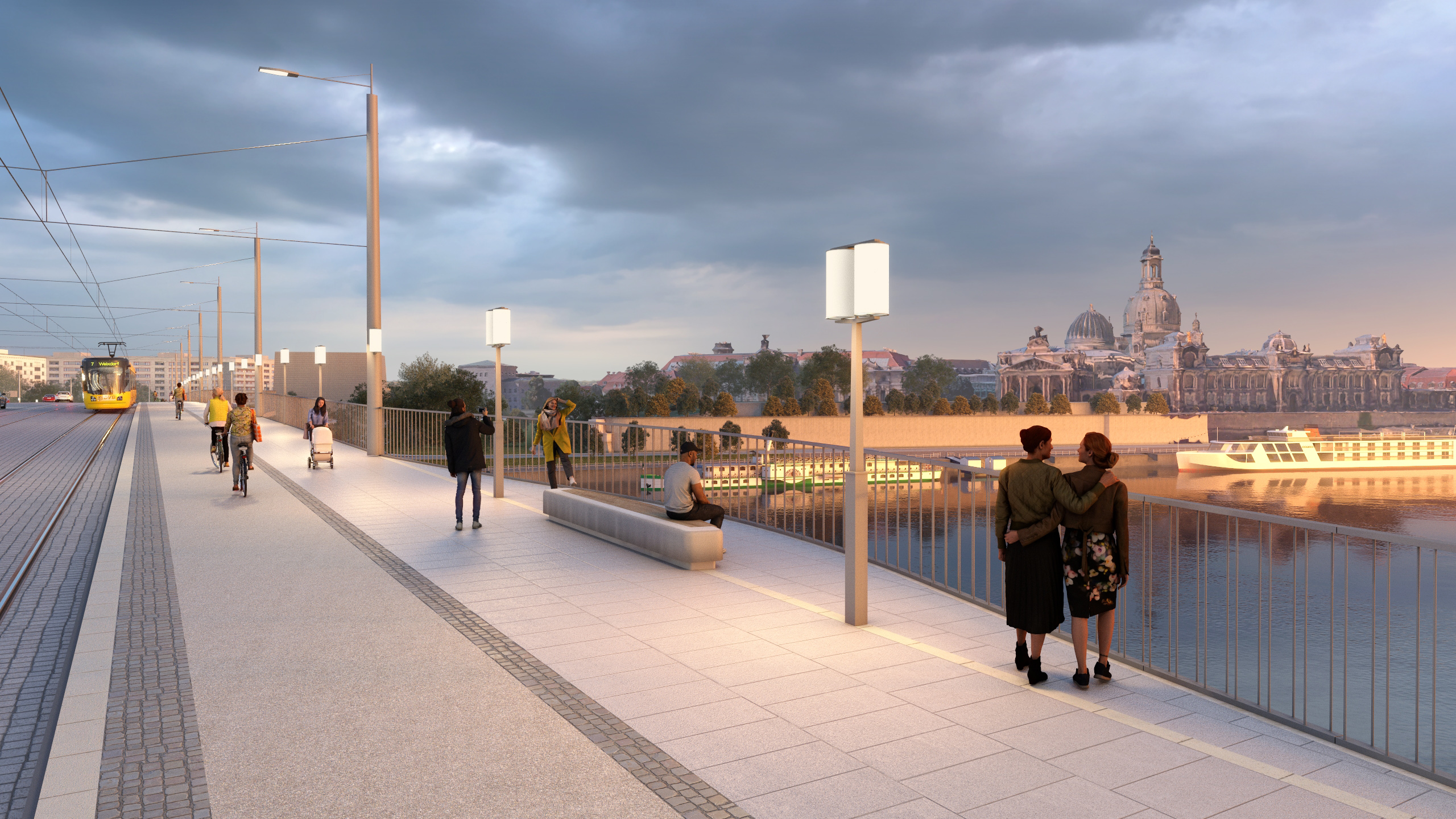
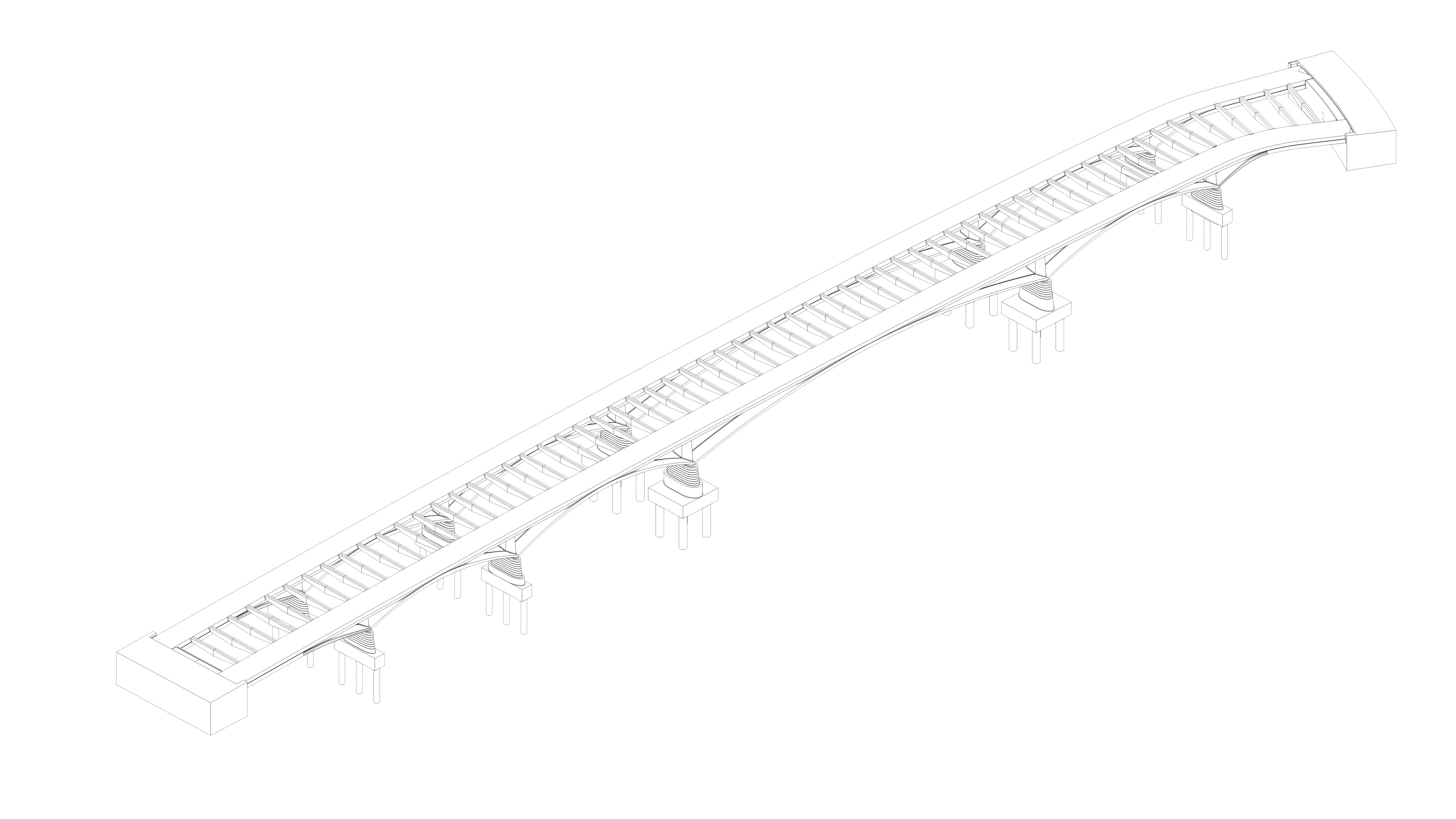
The proposed bridge follows a predominantly straight alignment in plan, with the exception of a curved connection at the southern end. The superstructure, with a width of 32.5 m over most of its length, locally widens over the piers to form small, cantilevered observation balconies, reaching a total width of 36.45 m at those points. On the south side, the superstructure additionally widens to accommodate the connection to the square. In elevation, the bridge follows a gentle curve with gradients of up to 4%, suitable for tram operation. The vertical alignment of the bridge has been set to meet both the clearance requirements for the navigation channel and the light space profile demands of the road.
The bridge superstructure accommodates two footpaths with integrated cycle paths, a dedicated tram corridor, and lanes for vehicular traffic. As explained below, the design not only considers the position of the tram on the side of the cross-section, as shown in the illustration, but also its central position. This allows the design to offer the option of relocating the tram toward the central axis of the bridge.

The bridge is arranged with a total of six spans measuring 42 – 58 – 120 – 60 – 50 – 42.1 m, resulting in a total length of 372.1 m between the axes of the abutment bearings.
DESIGN PHILOSOPHY
It is not often that a bridge in the heart of a historic city can be completely reimagined. The failure of the bridge built in 1971 presents Dresden with an opportunity. The unfortunate collapse of the bridge offers a chance to reconnect the city in a new way and to rethink the separated districts with an urban and engineering vision suitable for the 21st century.

In redesigning the bridge, we considered it essential to create a more compact and versatile structure that can respond to both current requirements and future changes. From our perspective, building a bridge with three separate superstructures, as in the Carola 2.0, is too inflexible and would occupy an excessive amount of space. It makes little sense to design a purely road or rail bridge, as it would not match the quality of the urban and landscape space.

Our intention, therefore, is to design a "calm" bridge—one where the experience of crossing is important for all users, including pedestrians and cyclists, as well as an appreciation of the structure itself. Citizens and visitors expect this new bridge to possess a design quality worthy of the city.

From the perspective of 21st-century engineering and architecture, it would not be appropriate to simply reconstruct what the first Carolabrücke once was: a 19th-century design, shaped by the technology of its time. That first bridge combined tradition—represented by the approach spans as stone masonry arches—with modernity, embodied by the three very flat steel arch spans, whose axial forces were introduced into massive masonry piers. The first Carolabrücke thus represented a synthesis of tradition and modernity. The same spirit has guided our design.

We propose a contemporary bridge that, with its classical character, also connects to the city’s structural history. Our solution is a multi-arch bridge that, on the one hand, responds to all existing boundary conditions and, on the other, becomes a bridge with character—one that can integrate dignifiedly into the city and be recognized as another bridge worthy of joining the ranks of Dresden’s significant historical bridges.
STRUCTURAL DESIGN AND TECHNICAL INTEGRATION
The proposed bridge follows a predominantly straight alignment in plan, with the exception of a curved connection at the southern end. The superstructure, with a width of 32.5 m over most of its length, locally widens over the piers to form small, cantilevered observation balconies, reaching a total width of 36.45 m at those points. On the south side, the superstructure additionally widens to accommodate the connection to the square. In elevation, the bridge follows a gentle curve with gradients of up to 4%, suitable for tram operation. The vertical alignment of the bridge has been set to meet both the clearance requirements for the navigation channel and the light space profile demands of the road.

The bridge superstructure accommodates two footpaths with integrated cycle paths, a dedicated tram corridor, and lanes for vehicular traffic. As explained below, the design not only considers the position of the tram on the side of the cross-section, as shown in the illustration, but also its central position. This allows the design to offer the option of relocating the tram toward the central axis of the bridge.

The bridge is arranged with a total of six spans measuring 42 – 58 – 120 – 60 – 50 – 42.1 m, resulting in a total length of 372.1 m between the axes of the abutment bearings.
Carolabrücke 3.0
Dresden, Germany
Structural typology Tender Design
Date Juni, 2026
Umfang Tender design
Cliente City of Dresden
Design fhecor
Collaboration TSSB | UKL
Owner City of Dresden
DESIGN PHILOSOPHY
It is not often that a bridge in the heart of a historic city can be completely reimagined. The failure of the bridge built in 1971 presents Dresden with an opportunity. The unfortunate collapse of the bridge offers a chance to reconnect the city in a new way and to rethink the separated districts with an urban and engineering vision suitable for the 21st century.

In redesigning the bridge, we considered it essential to create a more compact and versatile structure that can respond to both current requirements and future changes. From our perspective, building a bridge with three separate superstructures, as in the Carola 2.0, is too inflexible and would occupy an excessive amount of space. It makes little sense to design a purely road or rail bridge, as it would not match the quality of the urban and landscape space.

Our intention, therefore, is to design a "calm" bridge—one where the experience of crossing is important for all users, including pedestrians and cyclists, as well as an appreciation of the structure itself. Citizens and visitors expect this new bridge to possess a design quality worthy of the city.
From the perspective of 21st-century engineering and architecture, it would not be appropriate to simply reconstruct what the first Carolabrücke once was: a 19th-century design, shaped by the technology of its time. That first bridge combined tradition—represented by the approach spans as stone masonry arches—with modernity, embodied by the three very flat steel arch spans, whose axial forces were introduced into massive masonry piers. The first Carolabrücke thus represented a synthesis of tradition and modernity. The same spirit has guided our design.

We propose a contemporary bridge that, with its classical character, also connects to the city’s structural history. Our solution is a multi-arch bridge that, on the one hand, responds to all existing boundary conditions and, on the other, becomes a bridge with character—one that can integrate dignifiedly into the city and be recognized as another bridge worthy of joining the ranks of Dresden’s significant historical bridges.

STRUCTURAL DESIGN AND TECHNICAL INTEGRATION
The proposed bridge follows a predominantly straight alignment in plan, with the exception of a curved connection at the southern end. The superstructure, with a width of 32.5 m over most of its length, locally widens over the piers to form small, cantilevered observation balconies, reaching a total width of 36.45 m at those points. On the south side, the superstructure additionally widens to accommodate the connection to the square. In elevation, the bridge follows a gentle curve with gradients of up to 4%, suitable for tram operation. The vertical alignment of the bridge has been set to meet both the clearance requirements for the navigation channel and the light space profile demands of the road.

The bridge superstructure accommodates two footpaths with integrated cycle paths, a dedicated tram corridor, and lanes for vehicular traffic. As explained below, the design not only considers the position of the tram on the side of the cross-section, as shown in the illustration, but also its central position. This allows the design to offer the option of relocating the tram toward the central axis of the bridge.

The bridge is arranged with a total of six spans measuring 42 – 58 – 120 – 60 – 50 – 42.1 m, resulting in a total length of 372.1 m between the axes of the abutment bearings.
Carolabrucke 3.0 web_11108.jpg
02 summertime_IA_11095.jpg
alzado TSSB_11109.jpg
planta TSSB_11110.jpg
secciones TSSB_11111.jpg
06 kinder garden_IA_11096.jpg
compo 1_11103.jpg
09_under the bridge IA_11098.jpg
10 towards the city_11099.jpg
estructura AO copia_11104.jpg
LEGO model 1_11101.jpg
LEGO model 2_11102.jpg
compo3_11112.jpg
Standort
Related projects